Worried that your parcels carry a hidden cost? The most useful sustainable online shopping tips are simple: buy less, bundle orders, avoid returns and choose collection points.
This guide sits within the wider topic of sustainable ecommerce, which looks at how retailers, carriers and shoppers each shape the footprint of a parcel.
| Item | Value |
|---|---|
| Online shopping versus in-store shopping, carbon emissions and vehicle-miles travelled (as cited by a UC Davis professor) | 87% more efficient |
| Average share of online purchases returned (against physical stores) | 30% (versus around 8%) |
| Garment-industry returns that end up in landfill or are incinerated | 84% |
| Respondents willing to pay extra for lower-impact packaging (2018 study) | 77% |
| Expected rise in carbon emissions from urban delivery traffic with no interventions | 32% by 2030 |
| Possible cut in last-mile emissions through collection points | 17 to 26% by 2025 |
These figures come from a Florida Museum post and a Kuehne+Nagel feature, both from 2022. Figures can change, so check the source before you rely on them.
Is online shopping really greener than a trip to the shop?
It can be, but only when it is done well. Miguel Jaller, a professor of civil engineering at the University of California Davis, is cited as saying that shopping online is 87% more efficient than in-store shopping for carbon emissions and vehicle-miles travelled, in a September 2022 post from the Florida Museum’s Thompson Earth Systems Institute.
The same post warns that unchecked e-commerce can harm the environment through inefficient shipping, returns and excessive packaging. It also notes that e-commerce sales rose 43% in 2020, after the start of the pandemic.
Packaging adds to the load. The European Consumer Centre Europe Consommateurs says packaging, including overpackaging of online purchases, is estimated to represent almost a third of all household waste worldwide.
That is why the habits below focus on three things: what you buy, how it arrives and what happens to it afterwards.
Ask whether you need it before you click
The greenest parcel is the one you never order. REAL Sustainability suggests a few questions to ask before you push the button:
- Do you really need it?
- How many times will you use or eat it?
- Could you use or adapt something you already own?
- Do you know the product’s characteristics and size?
The last question comes from Europe Consommateurs, which also advises asking the right questions first to avoid over-consumption.
If you do need the item, the refurbished products buying guide is a good place to check whether a refurbished version would do the job.
The Florida Museum post adds two practical habits: use online shopping to replace, not add to, in-store shopping, and buy in bulk rather than as single-product purchases. It gives the example that online shopping could be the better option if the warehouse is far from your home, as noted in its eco-friendly online shopping tips.
How can you cut down on returns?
Returns are where online shopping often loses its green edge. In a November 2022 feature, the logistics provider Kuehne+Nagel wrote that on average 30% of items purchased online are returned, versus only around 8% of items bought in a physical store.
Fashion is a particular concern. The Florida Museum post says that in the garment industry, 84% of all returns end up in landfills or are incinerated.
Kuehne+Nagel adds that returns are not always resold, recycled or repurposed, so each one can mean extra emissions and extra waste. Europe Consommateurs lists 14 days’ no-hassle returns among the reasons people shop online, and that convenience is the very reason to order with care.
A few habits help:
- Minimise returns where you can, as the Florida Museum post advises.
- Avoid ordering several items just to try them on when you know you will probably send part of the order back.
- Consider “recommerce”: Kuehne+Nagel describes setting aside some returned goods for resale at a cheaper price.
Choose slower, bundled or collected delivery
Speed has a cost. The Florida Museum post explains that when you choose a slower delivery option, e-tailers can consolidate orders and work more efficiently.
REAL Sustainability describes Amazon Day as one example: Prime customers can choose which day of the week they want their orders, so items are shipped together in one box. You can apply the same idea with any seller by waiting until you have several things to buy from them, as described in its top tips.
Where the parcel is delivered matters too. Kuehne+Nagel quotes research saying that with no interventions, urban delivery traffic could see a 32% jump in carbon emissions by 2030, and a report it cites calculated that last-mile emissions could fall by between 17 and 26% by 2025 through collection points, according to its 2022 feature.
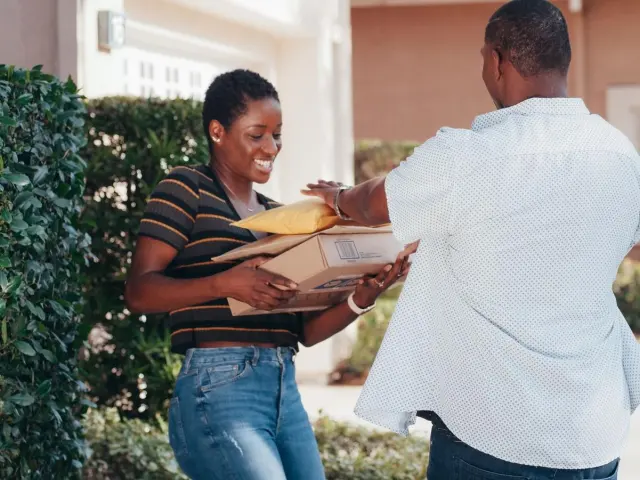
The logic is that the parcel travels the same distance, but if you cycle to a locker or collect it on a trip you would make anyway, the environment benefits a great deal.
Packaging and labels: what should you look for?
Many shoppers say they care. A study on European consumer packaging perceptions by Hitchin and Bitterman in 2018 found that 77% of respondents were willing to pay extra for packaging with less impact on the environment, according to Kuehne+Nagel.
When you can see how a seller packs, look for these signs:
- Right-sized boxes. Overpacking means fewer parcels fit in a delivery van, which raises the footprint per parcel.
- Cardboard you can recycle. Kuehne+Nagel notes that carton is more sustainable, but carton that is not reused or recycled might have a bigger ecological impact than plastic.
- Less plastic. It says parcels with non-recyclable, fossil-based materials such as plastic have the biggest ecological impact.
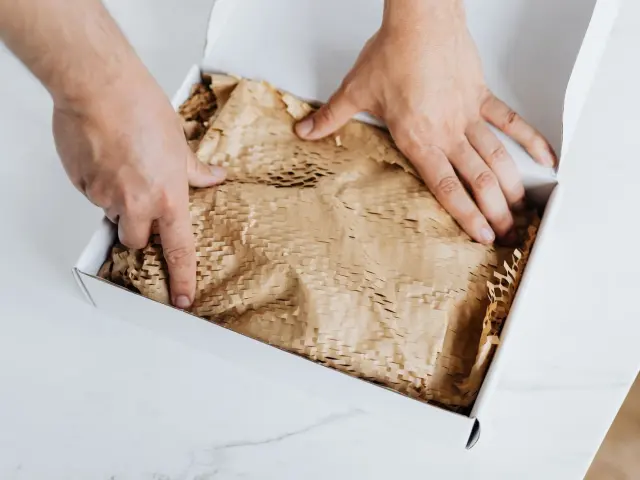
If a box arrives far too big for its contents, REAL Sustainability suggests putting pressure on the brand to cut packaging. Larger-than-necessary packaging takes up more room in vans, lorries and shipping containers.
Product pages are another place to be careful. Europe Consommateurs offers guidance on ecolabels and avoiding greenwashing, and the eco-friendly product labels ecommerce guide is a useful next read for judging claims.
A short checklist for your next order
- Pause and ask whether you need the item, or whether you could repair, borrow or reuse something instead.
- Check size and details closely so you do not need to send it back.
- Group your purchases with one seller and pick the slower delivery option.
- Choose a nearby collection point or locker if one is offered.
- Recycle the packaging correctly, and look for repair, reuse or resale when you no longer need the product.
The last step matters because Europe Consommateurs points to repair, reuse and recycling as ways to give your purchases a second life.
Frequently asked questions
Is online shopping better for the environment than going to a store?
Show answer
It can be. A UC Davis professor is cited by the Florida Museum as saying online shopping is 87% more efficient for carbon emissions and vehicle-miles travelled, but the same post warns that inefficient shipping, returns and excess packaging can undo the benefit.
Is slower delivery really greener?
Show answer
It gives sellers the chance to consolidate orders and work more efficiently, according to the Florida Museum post. Waiting and ordering several things at once is the simplest way to apply this.
Should you pick a collection point instead of home delivery?
Show answer
Often yes. Kuehne+Nagel argues that the benefit is largest when you collect by bicycle or on a trip you would have made anyway.
What should you do with items you no longer need?
Show answer
Try repair, reuse or recycling before throwing things away, as Europe Consommateurs suggests. For clothing, resale of returned or unwanted goods is one route, which Kuehne+Nagel calls recommerce.